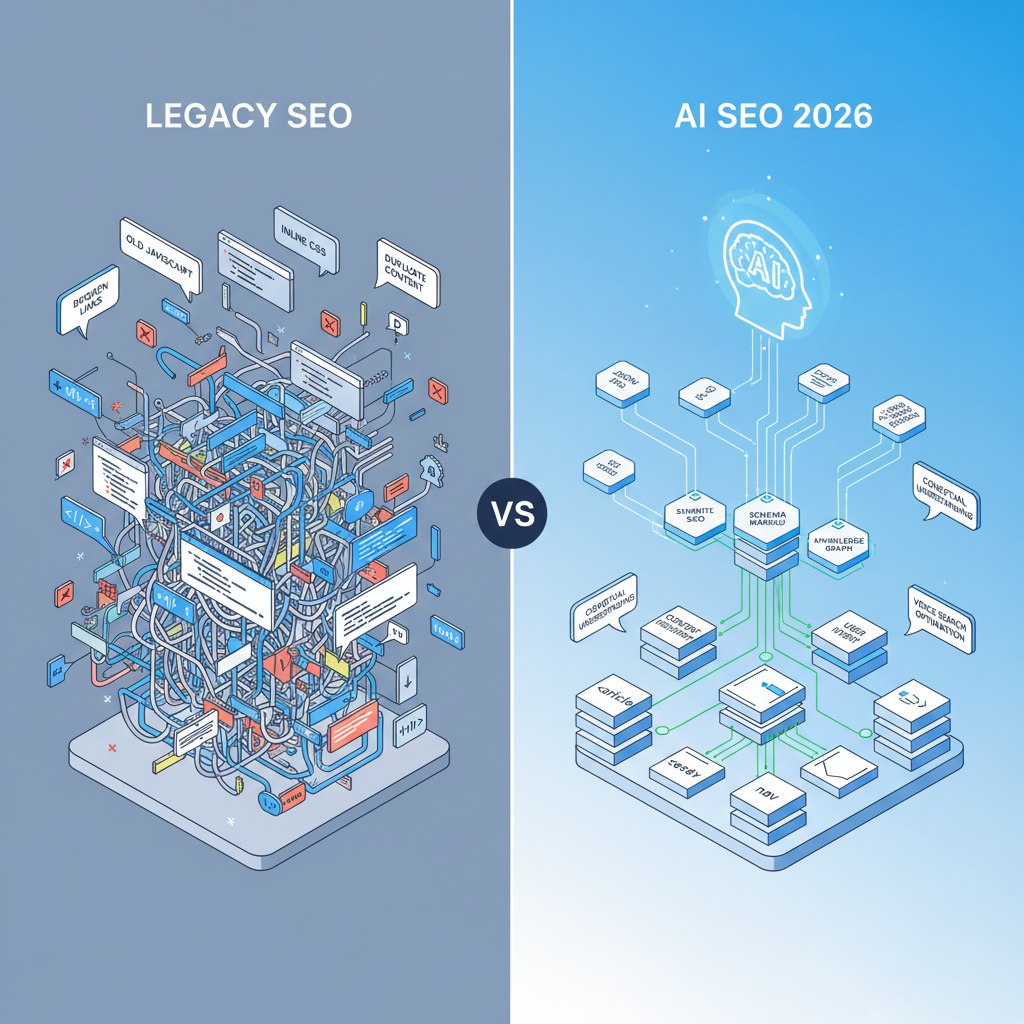
Let me be honest with you: keyword research is broken.
Not because the concept is wrong, but because the old way of doing it simply doesn't work anymore.
You know the drill. You open up your favorite keyword tool, export a massive spreadsheet of search volumes, spend hours trying to figure out what people actually want, build a content calendar, write articles, hit publish... and then cross your fingers hoping Google notices.
Spoiler alert: That approach is dying fast in 2025.
Here's why: search isn't just Google anymore. It's fragmented across traditional search results, AI-generated answers, featured snippets, and "zero-click" searches where users get their answer without ever visiting your site.
The sites that are winning right now? They're not just chasing individual keywords. They're building something bigger: connected topical authority. And they're doing it fast.
That's where AI comes in—not as a magic button, but as a genuine game-changer when used correctly.
Let me show you exactly how this works.
What AI Actually Does for Keyword Research (The Simple Version)
Think of AI as your research assistant who never sleeps and can process information at superhuman speed.
When you use AI for keyword research, you're able to:
- Find opportunities faster than any manual process
- Understand the real intent behind searches (not just the words people type)
- Identify content gaps you didn't even know existed
- Build a strategic plan that improves your entire site, not just individual pages
But here's the catch: AI alone isn't enough.
You need to combine AI's processing power with real performance data from tools like Google Search Console. And you need a system that doesn't just give you ideas, but actually helps you execute them.
That's the difference between "AI keyword research" and a system that actually moves the needle.
Why Manual Keyword Research Keeps Failing You
Let's talk about the three big problems with doing keyword research the old way:
Problem #1: You're collecting keywords, not building coverage
Getting a list of 500 keywords feels productive. But a spreadsheet doesn't automatically turn into topical authority.
You end up with disconnected articles that don't support each other, and Google sees your site as a collection of random posts rather than an authority on a topic.
Problem #2: You're sitting on hidden opportunities in your own site
Your Google Search Console is a goldmine of data. It's full of queries where you're getting impressions but no clicks, or where you're ranking on page 2 and just need a little push.
But most people never dig into this data because it's overwhelming and time-consuming to analyze manually.
Problem #3: You can't scale the important stuff
Even if you find great keywords, how do you:
- Group them into logical topic clusters?
- Map out how they connect to each other?
- Build an internal linking strategy that actually makes sense?
You can't. Not manually. Not at scale.
This is where AI stops being a nice-to-have and becomes essential.
9 Ways AI Transforms Keyword Research (When You Use It Right)
1. AI Maps Entire Topic Spaces, Not Just Keyword Variations
Traditional keyword tools give you variations: "best CRM," "top CRM software," "CRM tools comparison."
AI can map the entire topic universe around CRM software:
- What problems does it solve?
- What are the alternatives?
- What objections do buyers have?
- What related concepts do people need to understand first?
- What specific use cases exist?
This is how you build comprehensive coverage that Google and AI systems actually reward.
The best systems organize this into a clear hierarchy—think of it like a content pyramid with 5 levels: main pillars at the top, then clusters, supporting content, long-tail queries, and semantic variations at the base. This structure isn't just theoretical; it's how search engines understand topical depth.
Real example: Instead of just targeting "project management software," AI helps you understand you also need content about:
- Project management methodologies
- Team collaboration challenges
- Specific industry applications
- Integration requirements
- Migration from other tools
2. AI Classifies Intent Faster (And Intent Is What Actually Ranks)
Here's a truth bomb: the keyword isn't your strategy. Intent is.
Someone searching "what is CRM" needs a completely different page than someone searching "best CRM for small business" or "Salesforce vs HubSpot."
AI can instantly categorize keywords by intent:
- Informational: "what is," "how to," "guide to"
- Commercial: "best," "top," "reviews"
- Transactional: "buy," "pricing," "demo"
- Navigational: brand names, specific products
This prevents the most common ranking mistake: writing the wrong type of content for the query.
3. AI Makes Your Google Search Console Data Actually Useful
Your GSC data is the most valuable dataset you have. It shows you:
- What you're already ranking for
- Where you're getting impressions but no clicks
- Queries where you're stuck on page 2
- Topics where you have partial coverage
But it's messy. Really messy.
AI can process all that noise and tell you:
- "You're ranking #8 for this high-volume query—optimize this page"
- "You're getting 5,000 impressions but only 20 clicks here—fix your title and meta"
- "You rank for 50 variations of this topic but don't have a comprehensive guide"
This is how you compound what's already working instead of starting from scratch.
4. AI Does Competitor Analysis Without the Spreadsheet Hell
Competitor research isn't hard—it's just incredibly time-consuming.
AI can analyze your competitors and instantly show you:
- Topics they cover that you don't
- Content clusters where they have depth and you're thin
- Opportunities where you're actually better positioned to win
The goal isn't to copy competitors. It's to identify strategic gaps where you can build authority faster.
5. AI Turns Keywords Into Topical Authority
Here's the thing: if your keyword research doesn't end with a clear map, your execution will be random.
AI can organize everything into a topical hierarchy:
- Level 1: Main pillars (big themes)
- Level 2: Topic clusters (sub-categories)
- Level 3: Supporting content (specific angles)
- Level 4: Long-tail content (detailed questions)
- Level 5: Semantic variations (related concepts)
This structure is how you get site-wide ranking improvements, not just isolated wins on individual pages.
When you have this kind of map, you can make strategic decisions: Should you create a new cluster? Strengthen an existing one? Extend authority where you already have traction? These aren't guesses anymore—they're data-driven choices.
6. AI Makes Internal Linking Strategic Instead of Random
Most sites link randomly. "This seems related, so I'll link to it."
That's not a strategy.
AI can build a map-based internal linking architecture:
- Pillar pages link to cluster pages
- Cluster pages link to supporting content
- Authority flows intentionally from strong pages to new pages
- Links reinforce topical relationships
This is why AI-assisted research translates to rankings faster: authority flows where it's supposed to.
7. AI Reduces Content Waste
Most sites publish content that could rank but doesn't because:
- It targets the wrong intent
- It's missing important subtopics
- It's not connected to a cluster
- It has no internal link support
AI can help you create content that's:
- ✓ Aligned to the right intent
- ✓ Positioned inside a strategic cluster
- ✓ Supported by internal links
- ✓ Optimized for both Google and AI answer engines
When your content is created from a topical map rather than random keyword ideas, every piece serves a strategic purpose.
8. AI Optimizes for Multi-Platform Discovery
Search isn't just Google anymore.
People find content through:
- Traditional search results
- AI-generated answers (ChatGPT, Perplexity, etc.)
- Featured snippets
- Knowledge panels
All these systems prefer sites that demonstrate:
- Comprehensive topic coverage
- Clear, structured information
- Strong internal connections
- Consistent topical authority
AI helps you build exactly this kind of "source-worthy" site.
9. AI Makes Keyword Research Continuous, Not Quarterly
The biggest advantage? AI enables always-on optimization.
Instead of "we did keyword research in Q1 and we're done," you can run a continuous loop:
- New queries appear in your GSC
- New gaps emerge as your site grows
- Competitors publish new content
- Your content gets expanded, updated, and strengthened
Keyword research becomes a living system, not a one-time project.
Where "AI Keyword Research" Usually Goes Wrong
Not all AI keyword research is created equal. Here are the common pitfalls:
Pitfall #1: AI Hallucinates Demand
Chat models can invent keywords that sound plausible but have zero actual search volume.
The fix: Ground AI research in real data—your actual website, competitor analysis, and especially Google Search Console performance signals.
Pitfall #2: You Get Ideas, Not a Plan
A list of 1,000 AI-generated keywords isn't a strategy. It's just a bigger spreadsheet.
The fix: You need structured output—topical maps, intent clustering, gap prioritization, and clear next steps.
Pitfall #3: No Internal Linking = No Cluster Strength
Content without architecture rarely compounds. You publish great articles that sit in isolation.
The fix: Build internal linking architecture from your topical map, not random guesses about what "seems related."
Pitfall #4: Research Never Ships
Even brilliant keyword research dies in a Google Doc if you don't have a system to turn it into published content.
The fix: Connect research directly to content creation and publication workflows.
How to Actually Do AI Keyword Research (The Right Way)
Let me walk you through a practical approach that actually works:
Step 1: Start With Your Foundation
Connect your website and Google Search Console (if you have an existing site).
Run an analysis to understand:
- Your industry and niche
- Your current content structure
- Your competitor landscape
- Your existing topic footprint
This brand analysis phase is crucial—it ensures everything that follows is grounded in your actual business context, not generic recommendations.
Step 2: Run Deep Keyword Discovery
For new sites: Research your niche and competitors to find opportunities.
For existing sites: Combine niche research with GSC-driven opportunities:
- Keywords you're already ranking for
- Low CTR opportunities
- Content gaps based on what you almost rank for
The difference between good and great keyword research is whether it acknowledges what you've already built. Your existing rankings are assets, not starting points to ignore.
Step 3: Build Your Topical Map
Convert your keyword list into a topical authority structure with clear levels:
- Pillars → Clusters → Supporting content → Long-tail → Semantic variations
This is your strategic roadmap. It shows you not just what to write, but how everything connects.
Step 4: Prioritize Your Gaps
Don't try to do everything at once. Create a priority queue:
- Quick wins: High impressions, low clicks (optimize existing content)
- Authority builders: Deepen existing clusters where you have traction
- New clusters: Strategic expansion into adjacent topics
This is where most people get stuck. They have the research but don't know what to do first. A good prioritization system solves this.
Step 5: Create Content From the Map
Generate content based on:
- Your brand voice and positioning
- Your topical authority plan
- Keyword targeting
- Intent alignment
Not random articles—strategic pieces that fit into your larger structure.
Step 6: Build Internal Linking Architecture
Create intentional links:
- Pillar pages to cluster pages
- Cluster pages to supporting content
- Strategic authority distribution
This isn't something you do manually after publishing. It should be part of the plan from the beginning.
Step 7: Publish and Monitor
Get content live and track performance. Use new data to refine your approach continuously.
The best approach is to have your research system connected directly to your CMS—whether that's WordPress, Shopify, Webflow, or something else. The less friction between research and publication, the faster you see results.
From Theory to Practice: What This Actually Looks Like
Here's the reality check: everything I've described sounds great in theory, but most teams struggle with execution.
You might be thinking: "Okay, I understand the concepts. But how do I actually do this without hiring a team of SEO specialists?"
That's the right question.
The truth is, you have three options:
Option 1: Build it yourself
- Use ChatGPT or Claude for keyword ideas
- Manually organize into topic clusters
- Create spreadsheets for tracking
- Write content yourself or hire writers
- Manually build internal links
- Publish piece by piece
This works, but it's slow. Really slow. And the manual organization and linking parts are where most people give up.
Option 2: Hire an agency
- Pay $3,000-$10,000/month
- Wait weeks for strategy documents
- Hope they understand your brand
- Deal with communication overhead
- Still need to review and approve everything
This works if you have the budget and patience. Most growing businesses don't.
Option 3: Use a system that automates the pipeline
This is where tools like AltSchema come in. Full transparency: I'm not saying you need a specific tool. But you do need a system that connects all the pieces.
What makes a good system?
- Automated brand analysis so recommendations fit your actual business
- GSC integration to leverage your existing rankings
- Topical mapping (L1-L5 structure) that's automatic, not manual
- Gap prioritization so you know what to do first
- Content generation that understands your topical context
- Internal linking architecture built from the map, not guessed
- Direct publishing to your CMS so research actually ships
The reason I mention this is simple: the strategy I've outlined in this post works. But only if you can actually execute it consistently.
You can absolutely do this manually if you have the time and discipline. But if you're running a business, creating content, managing a team, and trying to grow—you probably don't.
That's why systems exist. Not to replace your thinking, but to handle the repetitive, time-consuming parts so you can focus on strategy and quality.
When You Should Still Use Human Judgment
AI is powerful, but it's not magic. You still need human oversight when:
- You're in a regulated industry (legal, medical, financial) where accuracy is critical
- Your brand has strict positioning and voice requirements
- You're launching something truly new where market demand isn't established yet
AI should augment your expertise, not replace it.
Even with the best systems, you should review priorities and messaging before publishing at scale. The goal is to make you more effective, not to remove you from the process.
Your Questions, Answered
"Does AI replace Google Search Console?"
No—AI is best when it uses GSC data. GSC gives you real demand signals. AI makes that data scalable and actionable.
"Will this actually improve my rankings?"
Yes, if it leads to:
- Better intent matching
- Deeper topic coverage
- Stronger internal linking
- More comprehensive content
AI helps with speed and structure. Rankings come from execution quality.
"How is this different from keyword generator tools?"
Most AI keyword tools give you lists. What you need is a complete pipeline:
Research → Topical mapping → Gap analysis → Content creation → Internal linking → Publishing
That's the difference between ideas and results.
"Is this only for new websites?"
Actually, it's especially powerful for existing sites because you can leverage your GSC data to find quick wins and build on what's already working.
"Can I do this without expensive tools?"
Yes, but it requires significant time investment. You can use free AI tools for research, manually create your topical maps, organize your own internal linking, and publish piece by piece.
The question is: what's more valuable to your business—your time or the cost of automation?
The Bottom Line
Keyword research isn't dead—but the old way of doing it is.
In 2025, winning sites don't just target keywords. They build connected topical authority using AI to:
- Process information at scale
- Identify strategic opportunities
- Create structured content plans
- Build internal linking architecture
- Execute continuously, not quarterly
The question isn't whether to use AI for keyword research.
The question is: Are you using it as part of a complete system, or just generating bigger spreadsheets?
Because one approach builds sustainable organic growth. The other just creates more work.
You can build this system manually if you have the time and discipline. Or you can use tools designed specifically for this workflow—like AltSchema or similar platforms—that automate the pipeline from research to publication.
Either way, the strategy remains the same: stop chasing individual keywords and start building topical authority systematically.
Choose wisely.
Ready to transform your keyword research from a quarterly chore into a continuous growth system? The future of SEO isn't about working harder—it's about working smarter with the right tools and strategy.