
TL;DR Summary
• Alt text validation tools automate the detection of missing, brief, or poorly optimized image descriptions across entire domains.
• Modern systems leverage artificial intelligence to evaluate semantic context rather than just checking for character counts.
• Adhering to accessibility standards is now a non-negotiable baseline for both user experience and search engine visibility.
• Integrating validation directly into your publishing workflow prevents technical debt and formatting errors before they go live.
• Free Alt Text validation tool

Managing website accessibility and search visibility requires absolute precision. Alt text validation tools serve as the crucial diagnostic layer between your visual assets and search engine crawlers. We rely on these systems daily to ensure that every image on a site contributes positively to its overall architecture.
When we audit enterprise sites, we frequently uncover thousands of images lacking proper descriptive attributes. Fixing this manually is inefficient. Automated validation provides the scale necessary to identify gaps, assess contextual relevance, and maintain compliance with modern search protocols.
Table of Contents
• The Core Mechanics of Alt Text Validation Tools
• Evaluating Top Validation Features and Capabilities
• Identifying Common Failures in Image Optimization
• Choosing the Right Validation Solution for Your Stack
• Frequently Asked Questions (FAQ)
The Core Mechanics of Alt Text Validation Tools
Understanding what happens under the hood of these diagnostic applications helps clarify their value. They do much more than simply verify if an HTML attribute exists.
How These Tools Analyze Image Context
At their foundation, validation crawlers parse your website's Document Object Model (DOM) to locate every <img> tag. Once identified, the tool extracts the alt attribute and evaluates its contents. Early iterations of these tools simply flagged empty attributes. Today, sophisticated alt text validation tools analyze the surrounding text, the image file name, and the structured data to determine if the description accurately reflects the visual context.
For instance, if an article discusses "solar panel installation," a basic tool might accept "solar" as valid alt text. A modern validator will flag this as insufficiently descriptive, prompting the user to provide a more comprehensive explanation of the specific image.
AI Integration vs. Traditional Heuristics
We have observed a massive shift from rule-based heuristics to machine learning models in validation software. Traditional tools operate on rigid parameters, while AI-driven tools understand semantic relationships.
Feature | Traditional Heuristic Tools | AI-Powered Validation Tools |
|---|---|---|
Detection Method | Checks for presence of | Analyzes image pixels and text semantics |
Quality Assessment | Character count limits | Contextual relevance scoring |
Decorative Images | Often flags intentional nulls as errors | Accurately identifies decorative elements |
Automation | Requires manual writing | Can suggest context-aware descriptions |
Why Manual Checks Still Matter in 2026
Despite the advancements in automation, human oversight remains critical. AI models can hallucinate or misinterpret complex data visualizations. We always recommend a hybrid approach: allow the software to handle the bulk auditing and flagging, but require a human reviewer to approve descriptions for highly technical diagrams, branded infographics, or culturally nuanced imagery.
Evaluating Top Validation Features and Capabilities
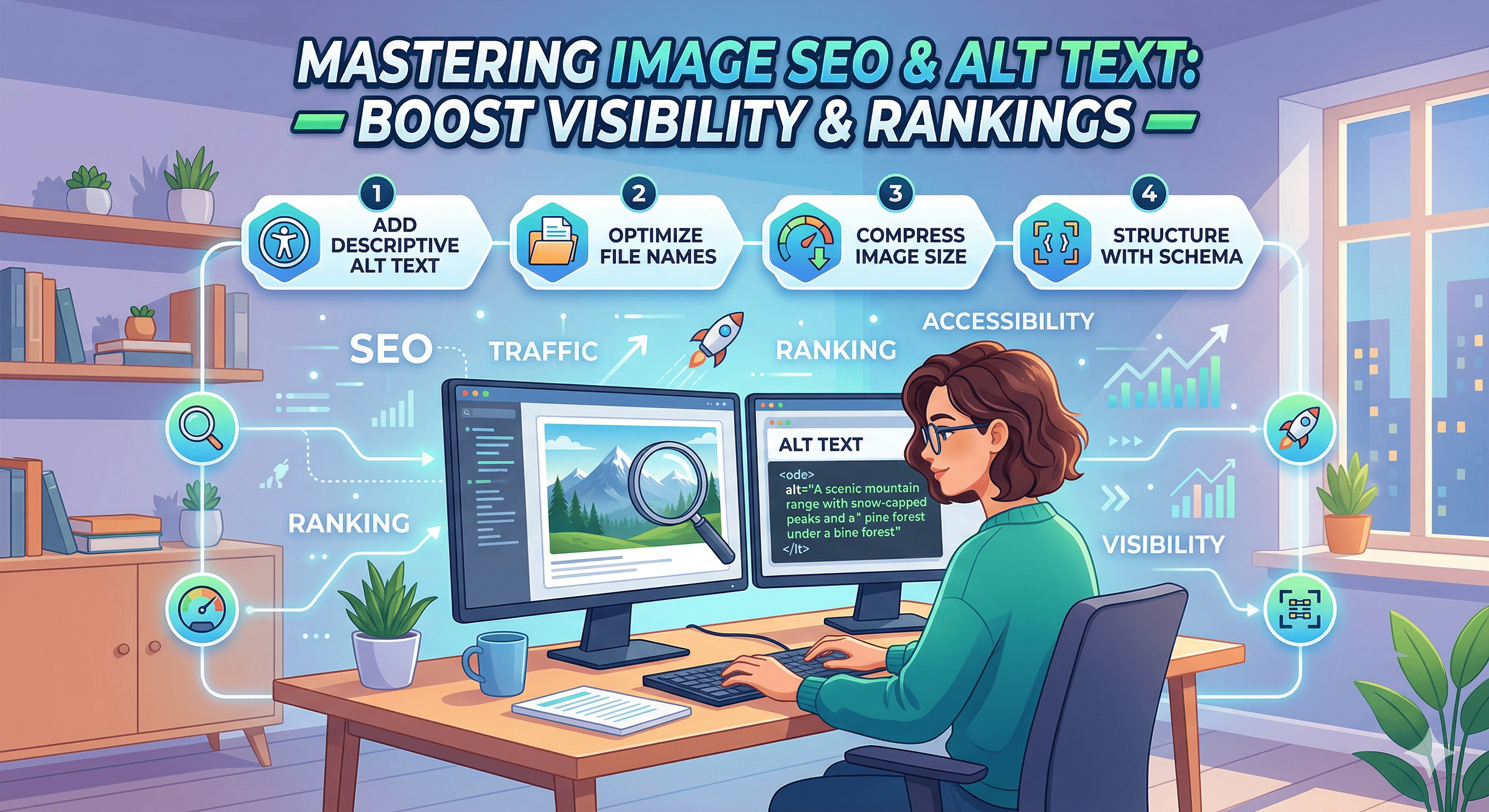
Not all diagnostic software is created equal. When selecting a tool for your organization, specific capabilities dictate how effectively you can scale your optimization efforts.
Accessibility Compliance (WCAG 2.2 Standards)
The primary mandate for image descriptions is accessibility for visually impaired users utilizing screen readers. High-quality validation tools explicitly measure your attributes against the Web Accessibility Initiative (WAI) standards. They check for redundant phrasing (e.g., "Image of...") and ensure that functional images, like buttons or linked graphics, describe their destination or action rather than just their appearance.
SEO Context and Keyword Density Checks
Search engines use image descriptions to understand topical relevance and rank visual assets in image search results. A robust tool evaluates whether your primary keywords are integrated naturally. It will calculate keyword density within your media library, warning you if you are crossing the line into spam territory. This ensures alignment with modern web accessibility guidelines while maximizing ranking potential.
Bulk Processing and Automation Workflows
For agencies and large publishers, scanning one page at a time is impossible. Enterprise-grade tools offer bulk processing, allowing you to crawl tens of thousands of URLs overnight.
Site-wide Crawling: The tool maps all media assets across the domain.
Categorization: It groups errors by severity (e.g., missing entirely vs. poorly optimized).
Export & Integration: Data is exported to CSV or pushed directly into a CMS via API for immediate correction.
Identifying Common Failures in Image Optimization
In our analysis of thousands of web pages, we consistently see the same patterns of failure. Validation software is specifically designed to catch these exact scenarios.
The Problem with Keyword Stuffing
One of the most frequent errors we encounter is the over-optimization of image attributes. Marketers sometimes treat the alt text field as a hidden container for target phrases.
For example, instead of describing a photograph as "A red sports car parked in front of a brick building," a stuffed attribute might read "red sports car fast car buy sports car online." Validation tools apply linguistic analysis to flag this unnatural phrasing, protecting your site from algorithmic penalties.
Missing Context for Complex Visuals
Charts, graphs, and infographics present a unique challenge. A brief description is insufficient for a complex data visualization.
Visual Type | Poor Alt Text Example | Validated Alt Text Example |
|---|---|---|
Bar Chart | "Sales chart" | "Bar chart showing Q3 2026 revenue growth of 15% across North America" |
Headshot | "John Doe" | "John Doe, Chief Marketing Officer, speaking at the 2026 SEO Summit" |
Product | "Shoe" | "Men's running shoe in neon green with breathable mesh upper" |
Decorative Images and Null Alt Attributes
Not every image requires a description. Spacers, background patterns, and purely aesthetic flourishes should be ignored by screen readers. According to the technical documentation for image elements, these require a null attribute (alt=""). Poorly configured validation tools will flag these as errors, creating false positives. Advanced tools recognize decorative context and validate the null attribute correctly.
Choosing the Right Validation Solution for Your Stack
Selecting the appropriate software depends on your specific operational needs, budget, and technical expertise.
Standalone Validators vs. Integrated SEO Platforms
Standalone tools are often lightweight browser extensions or simple web apps. They are excellent for quick, single-page checks. However, integrated platforms provide a holistic view. By combining image validation with comprehensive SEO audits, you can correlate media optimization directly with traffic metrics and overall site health.
API Availability for Enterprise Operations
For businesses managing headless CMS architectures or custom web applications, API access is mandatory. An API allows developers to build validation directly into the deployment pipeline.
• Pre-publish checks: Prevent authors from publishing content with missing image descriptions.
• Continuous monitoring: Automatically scan user-generated content upon upload.
• Custom reporting: Feed validation data into internal BI dashboards.
Nuwtonic's Approach to Automated Validation
At Nuwtonic, we view image optimization as an interconnected part of your broader digital strategy. Our technical SEO platform doesn't just flag missing attributes; it leverages AI-driven content generation to suggest highly relevant, context-aware descriptions. We prioritize a workflow where the system does the heavy lifting of auditing and drafting, leaving the user in complete control of the final review and publication process.
Free Alt Text validation tool
You can use different free SEO Tools such as nuwtonic free alt text validator which can take one url as an input and validate whether your alt text has any issues or it is perfect or not , on the other hand you can use free Alt text generator tools like Nuwtonic AI Alt Text generator where you can upload Image and generate very accurate and dynamic alt text for that image for free.
Frequently Asked Questions (FAQ)
What makes a validation tool effective?
An effective tool must balance strict technical compliance with semantic understanding. It should accurately identify missing attributes, flag keyword stuffing, recognize decorative images, and provide actionable suggestions without overwhelming the user with false positives.
Can AI write perfect alt text?
Currently, AI is highly proficient at describing standard photographs and common objects. However, it struggles with nuanced context, brand-specific terminology, and complex data interpretation. AI should be used to draft descriptions at scale, but human review is still necessary for critical assets.
How often should we audit image attributes?
We recommend implementing continuous validation during the publishing process. For legacy content, a comprehensive sitewide audit should be conducted quarterly to catch broken images, outdated descriptions, and technical regressions.
Sources & References
• W3C Web Accessibility Guidelines
• Google Search Central Documentation on Image Optimization
• Industry standards for DOM parsing and semantic HTML evaluation