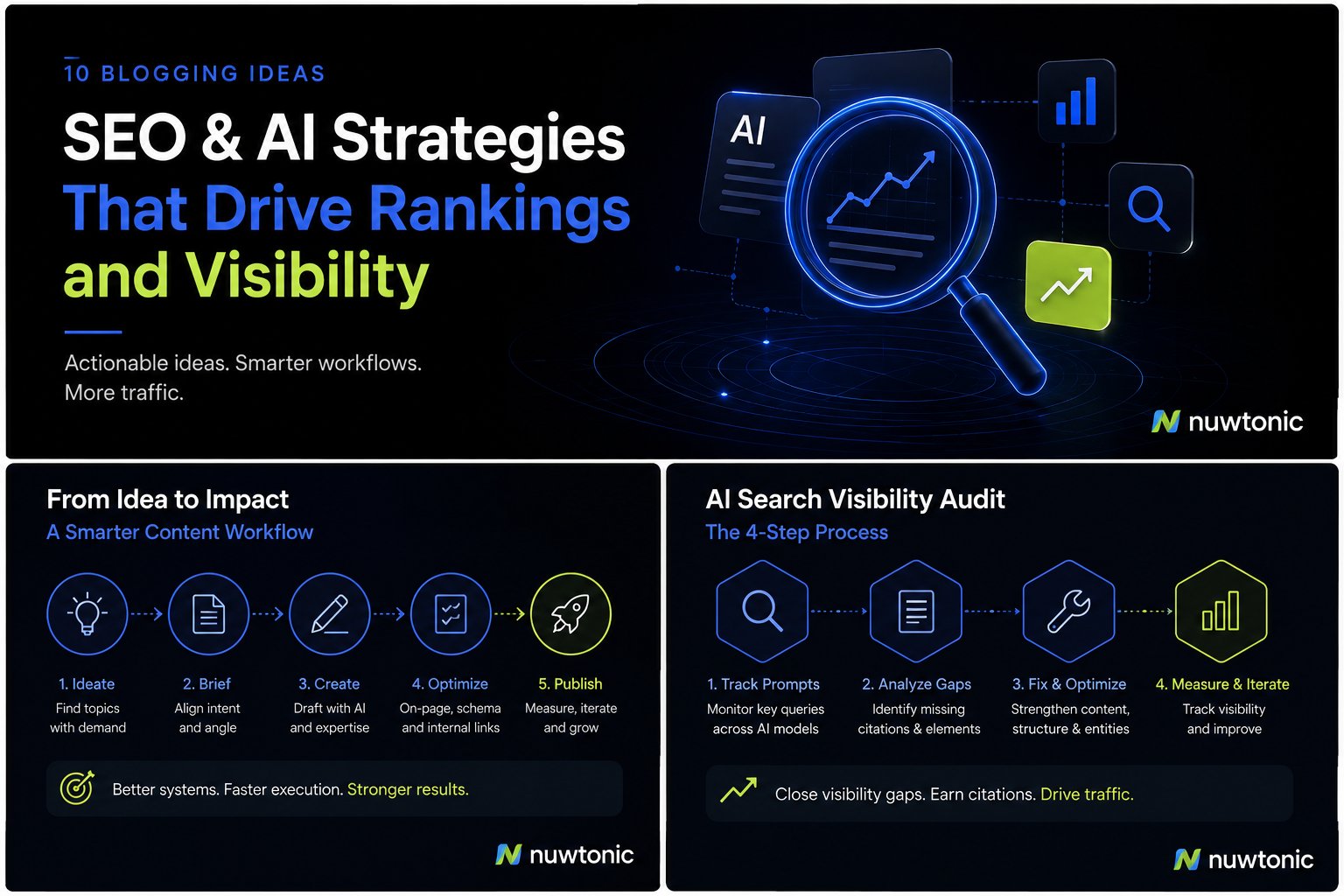
A familiar scenario plays out in content teams every week. The topic list looks healthy, but a post stalls once the actual work starts: validating search demand, choosing the angle, shaping the brief, tightening the draft, and fixing metadata, schema, and internal links before publication. The delay is not usually caused by a lack of ideas. It comes from weak execution systems.
The modern blogging environment rewards usefulness and execution quality over volume. Strong topics now need keyword intent, SERP context, AI search visibility, and a production process that shortens the distance between brief and publish-ready asset. Teams that treat ideation as a standalone task often produce content that is late, misaligned, or too generic to win distribution. Teams that pair each topic with prompts, workflows, and optimization rules publish faster and give each post a clearer path to traffic.
That is the approach in this guide. These 10 blogging ideas are designed as executable content plays, not broad inspiration. Each one connects a topic angle to SEO keyword prompts, headline formulas, AI writing prompts, and practical workflows mapped to Nuwtonic modules so teams can move from concept to draft to optimization without wasted cycles. If AI visibility is part of your content goals, Nuwtonic's guide on how to optimize content for AI search gives useful context for how those workflows translate into discoverability.
Table of Contents
2. Mapping Competitor Content Gaps and SERP Intent Shifts to Recover Share of Voice in Your Category
8. Cross-cutting Implementation Workflow From Audit to Iteration
9. Common Measurement Metrics for SEO and AI Visibility Work
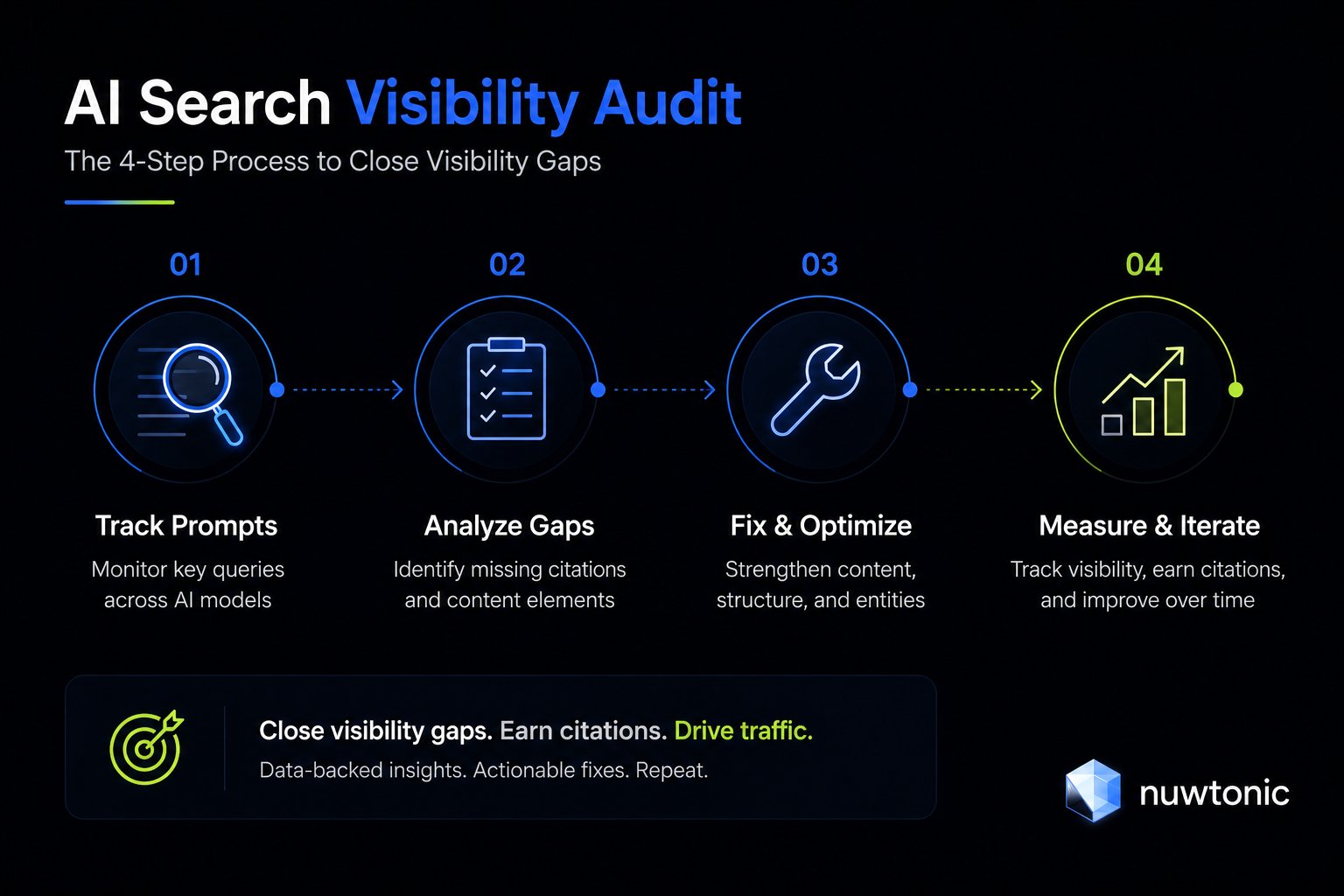
1. How to Audit and Fix AI Search Visibility Gaps Using Prompt Tracking Across ChatGPT, Gemini, Perplexity, and Claude
A buyer asks ChatGPT for the best payroll platform for multi-state teams. Your company ranks on Google for related terms, but the AI answer cites three competitors and none of your pages. That gap is no longer theoretical. It affects evaluation, shortlist inclusion, and branded search demand upstream of the click.
That makes this one of the strongest ideas for blogging if you want a post that can rank, earn citations, and convert operational interest into pipeline. The angle is practical: pair the topic with SEO keyword prompts, headline formulas, AI drafting instructions, and a workflow inside Nuwtonic so a team can move from audit to publish-ready article without rebuilding the process each time.
Start with prompts that map to commercial decisions
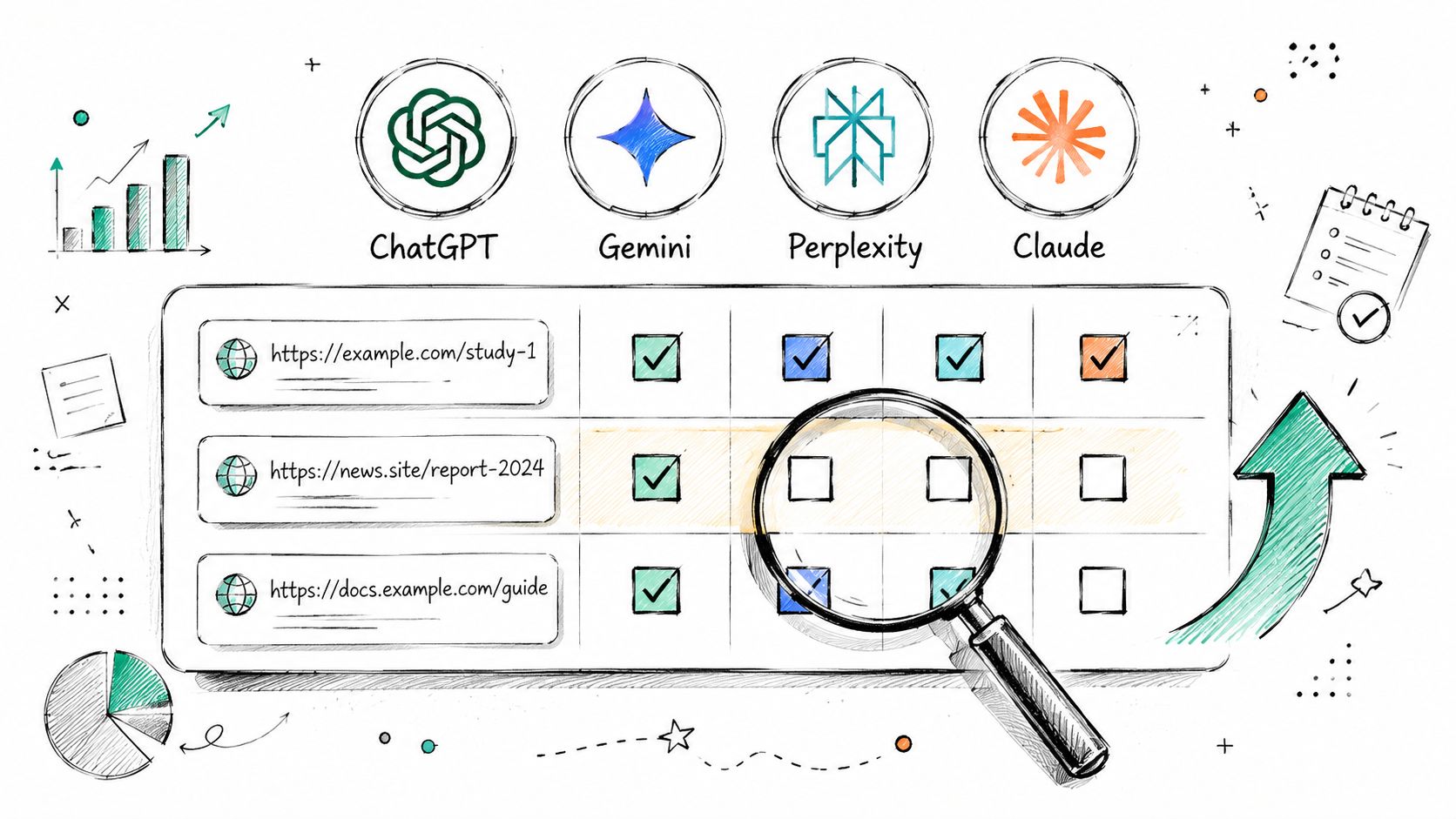
Use prompts that mirror how prospects compare, qualify, and narrow options. A project management software company should track queries such as “best project management software for remote teams,” “best project management software for SMBs,” and “project management platform for enterprises” across ChatGPT, Gemini, Perplexity, and Claude. Then log which domains appear, which URLs get cited, and what content format each model seems to prefer.
A simple audit sheet works well with five columns: prompt, model, cited URL, missing element, next fix.
The pattern usually becomes clear fast. Perplexity may favor pages with explicit sourcing and fresher references. Claude may surface pages with cleaner procedural structure. Gemini may reward tighter entity associations between the brand, product category, use case, and audience segment. Those differences give you publishable blog angles and concrete page fixes at the same time.
What to check when your page is missing
Missing citations usually come from one of four issues:
Entity ambiguity. The page does not state clearly what the company is, who it serves, and what job the product handles.
Weak answer structure. The page buries definitions, steps, comparisons, or limitations below generic copy.
Thin support signals. Internal links, related cluster content, schema, examples, and source references do not reinforce the main claim.
Prompt mismatch. The page targets a broad head term while the model is answering a narrower audience or use-case variant.
Nuwtonic's AI search optimization workflow helps connect those findings to structural fixes. For gap discovery at the topic level, use a documented content gap analysis workflow for SEO teams before you decide whether to refresh an existing URL or publish a new one.
Turn the audit into a blog post teams can ship fast
This topic performs well because it produces evidence, not opinion. Readers can repeat the process on their own site, and that usually leads to stronger saves, shares, and internal distribution.
Use this production framework:
Primary keyword prompts: “AI search visibility audit,” “track citations in ChatGPT,” “Perplexity citation analysis,” “Claude answer visibility,” “Gemini brand mention audit”
Headline formulas:
“How to Audit AI Search Visibility for [Industry]”
“Why [Brand Type] Gets Ignored in ChatGPT and How to Fix It”
“A Prompt Tracking Framework for ChatGPT, Gemini, Perplexity, and Claude”
AI content prompt: “Draft a practical guide for auditing AI answer visibility across ChatGPT, Gemini, Perplexity, and Claude. Explain how to build a prompt set, log citations, diagnose missing entities and structure, and prioritize fixes for commercial pages and supporting content.”
Nuwtonic execution workflow: Use Research to collect prompt variants by funnel stage. Use SEO analysis to map cited competitor pages and on-page gaps. Use content generation to build the article outline around findings. Use Smart AI Edit to tighten sections, add examples, and align headings with search intent before publication.
A legal services firm can apply the same method to a narrower query such as “how to respond to an LLC lawsuit.” If one model cites the firm and others do not, the issue is often procedural clarity or missing legal entity context, not page authority alone.
For a second perspective on how to evaluate missing-topic opportunities around this process, the Taja AI blog post is a useful reference.
2. Mapping Competitor Content Gaps and SERP Intent Shifts to Recover Share of Voice in Your Category
A category page still ranks in position three. Traffic drops anyway. Sales teams report weaker lead quality, and competitors start showing up for comparison, integration, and alternatives queries that sit closer to a buying decision. The ranking report looks stable. The intent coverage does not.
That gap creates one of the strongest ideas for blogging because it ties editorial planning to measurable share-of-voice recovery. The goal is not to publish more posts than competitors. The goal is to identify where their pages satisfy search intent better, then turn those findings into publish-ready briefs, headline angles, and on-page updates your team can ship quickly with Nuwtonic.
How to map the gap correctly
Use three inputs together. Pull GSC queries that already generate impressions. Compare them against competitor rankings by modifier and page type. Then review the live SERP to see what Google currently rewards for that intent class, such as comparison tables, integration details, pricing context, reviews, FAQs, or product-led templates.
This method surfaces a pattern many teams miss. The gap is often not a missing keyword. It is a missing intent treatment.
A SaaS company may rank for a core feature term but lose visibility on "[feature] with Salesforce" or "[feature] for agencies" because the page is written as a product overview while competitors publish implementation-focused pages. A retailer may hold visibility on a category query yet lose clicks because competitor pages package the same products inside gift guides, seasonal comparisons, or "best for" frameworks that match the SERP more closely.
If you want a repeatable process for this audit, Nuwtonic's content gap analysis guide is a strong reference point for turning observed gaps into prioritized patch plans.
What makes this a strong blog topic
This angle works because readers can apply it immediately. The article can show a before-and-after scenario, explain how intent shifted, and document the exact content changes that closed the gap. That is more useful than another generic post about "finding keywords."
A strong version of this article usually includes one category-level example and one page-level example. For instance, a project management company might discover that competitors win "project management Slack integration" with pages that include setup steps, screenshots, pricing implications, and common workflow questions. Their existing feature page mentions Slack once. It does not answer the task the searcher is trying to complete.
That distinction matters in editorial planning. Teams should create a new post when the SERP rewards a distinct intent class. They should patch an existing page when the intent is adjacent and the current URL already has relevance.
Topic prompts, headline formulas, and AI production inputs
This section becomes more useful when each idea includes the keyword prompt, the headline pattern, the AI brief, and the publishing workflow.
Primary keyword prompts: “content gap analysis for SaaS,” “competitor keyword gap blog strategy,” “SERP intent shift analysis,” “how to find missing search intent in Google results,” “share of voice recovery content plan”
Headline formulas:
“How to Find Competitor Content Gaps in [Category] and Turn Them Into Ranking Opportunities”
“Why Competitors Win the Click for [Topic] Even When You Rank Nearby”
“A Share of Voice Recovery Framework for [Industry] Using SERP Intent Mapping”
AI content prompt: “Draft a practical article for [industry] on identifying competitor content gaps and SERP intent shifts. Separate informational, commercial, and comparison intent. Show how to decide between creating a new article, expanding an existing page, or changing the page format. Include examples of modifiers such as integrations, alternatives, pricing, and use cases.”
Nuwtonic execution workflow: Use Research to cluster competitor topics by intent and modifier. Use SEO analysis to compare ranking pages, snippet patterns, and on-page coverage. Use content generation to build an outline around the highest-value missing angles. Use Smart AI Edit to refine headings, strengthen intent match, and convert findings into a brief your team can publish without extra rewriting.
One useful rule is simple. Measure the gap at the query level, then decide the asset type at the intent level.
For another perspective on identifying missing subtopics and converting them into assignments, the Taja AI blog post is a useful companion resource.
3. Running a Sitewide Cannibalization Audit and Implementing Conflict Resolution to Stop Internal Competition and Recover Lost Rankings
Some blogs don't have an idea shortage. They have too many overlapping ideas published without a clear owner URL. That creates cannibalization. Three pages target the same phrase, all of them partially rank, none of them fully wins, and internal links inadvertently reinforce the wrong page.
This is a powerful blog topic because readers immediately recognize the pain. E-commerce sites often have separate category, comparison, and seasonal pages covering close variants. SaaS teams publish use-case posts that overlap with landing pages. Publishers keep annualized versions of evergreen pieces alive long after they should have been consolidated.
How to find the winning page
Pull your top queries from GSC across a longer comparison window, then list every URL that receives impressions for those same terms. The pattern usually exposes itself quickly. One page may earn stronger click-through, another may have more links, and a third may just exist because no one retired it.
A retailer with “winter boots,” “snow boots,” and “cold weather boots” pages can turn this into an excellent educational post. So can a SaaS team with “[feature] for remote teams” and “remote team project management” pages competing internally. The article becomes stronger when you explain the merge-versus-redirect-versus-rewrite decision logic instead of saying “delete duplicates.”
Conflict resolution workflow
Write the post around a decision framework readers can apply immediately:
Merge: Use when two pages satisfy the same intent and one has stronger authority.
Redirect: Use when a weaker page adds little standalone value and should transfer signals.
Rewrite: Use when both pages deserve to exist but need clearer intent separation.
Re-link: Use when internal anchors keep reinforcing the wrong destination.
Field note: Cannibalization isn't always duplicate wording. It's often duplicate intent with slightly different titles.
This topic also solves a recurring pain point in underserved-topic research. Existing advice often stays generic, while stronger teams use GSC-driven topical maps and cannibalization tracking to uncover overlooked angles, as noted in Ignite First's underserved topic analysis.
For the AI prompt, use: “Draft an operational guide for resolving keyword cannibalization. Include query mapping, page authority comparison, redirect criteria, and internal linking cleanup steps.” That produces a publishable first draft your editor can tighten around your own examples.
4. Turning GSC Query Data Into Prioritized On-Page Fixes Using Metadata Schema and Content Optimization
A common failure pattern looks like this. An SEO lead exports Google Search Console queries, sorts by impressions, and sends a spreadsheet to content. Nothing changes because the team has no rule for deciding whether a query problem needs a title rewrite, a schema update, a section expansion, or a full refresh.
That decision layer is what makes this a strong blog topic. It gives readers a repeatable system they can use immediately, and it fits Nuwtonic's angle well because the post can pair a topic idea with SEO keyword prompts, headline formulas, AI prompts, and a workflow that moves from diagnosis to publish-ready updates fast.
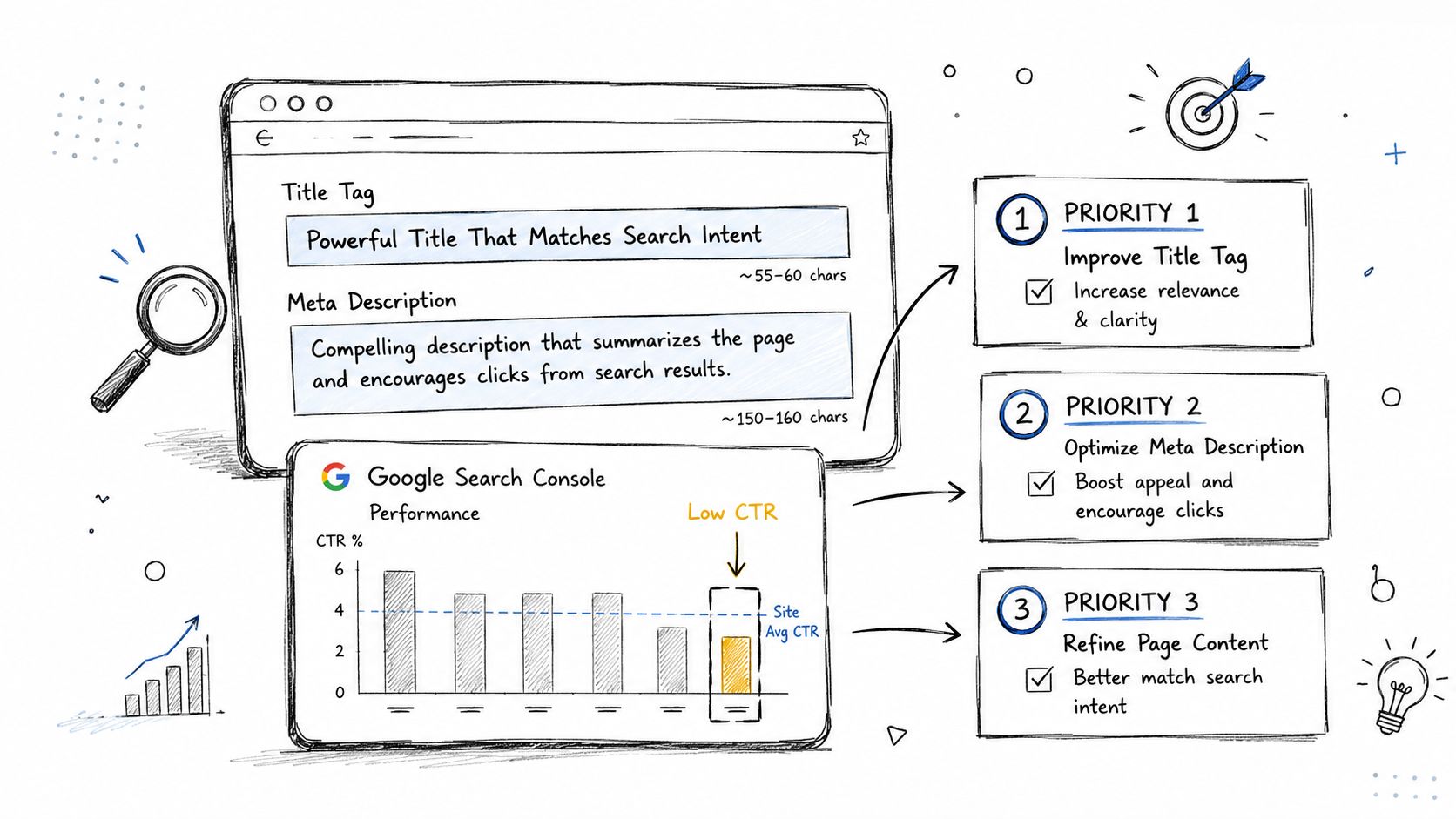
Classify the gap before editing the page
GSC query data becomes useful when you group problems by page-query mismatch, not by raw volume alone.
Low CTR with strong average position usually points to snippet weakness. The page is getting seen but not chosen. In practice, that often means the title tag buries the modifier users care about, the meta description fails to frame the benefit clearly, or the result lacks supporting schema that improves how the listing appears.
High impressions across many long-tail variants often signal incomplete coverage. The page is adjacent to user intent, but it does not answer enough sub-questions to win more clicks or support stronger relevance. Query modifiers such as “how,” “best,” “template,” “pricing,” and “vs” give you a clean way to decide which sections to add and how to reorder them.
A third pattern matters too. If one page ranks for informational queries and commercial investigation queries at the same time, weak engagement can come from mixed intent rather than weak writing. The fix is usually sharper metadata, clearer section hierarchy, and stronger internal linking to the page that should own the adjacent intent. Nuwtonic's guide to an internal linking audit for SEO is useful here because internal anchors often reinforce the wrong page-query relationship.
Turn query patterns into specific on-page actions
The article works best when it gives readers a decision framework they can apply without guessing:
Low CTR, stable rankings: Rewrite title tags and meta descriptions first. Front-load the key modifier, tighten the promise, and match the dominant SERP wording pattern.
Broad query spread, weak engagement: Expand or reorganize the article. Add missing subsections, FAQs, examples, comparison tables, or visuals based on recurring modifiers.
Weak snippet format fit: Add or correct schema where relevant, especially FAQ, Article, Product, or Review markup if the page type supports it.
Intent mismatch on one URL: Rework headings, intro copy, and section order so the primary intent is obvious in the first screen.
Visual-intent queries underperforming: Improve image context, file labels, captions, and alt text. Then add screenshots, diagrams, or step visuals that match the query pattern.
This approach avoids the generic advice to “optimize content.” It tells the reader what to change, why to change it, and what signal triggered that decision.
Build the post around reusable assets
A higher-value version of this blog idea includes prompts and production assets readers can reuse across pages.
SEO keyword prompts: “GSC query optimization workflow,” “improve organic CTR with metadata updates,” “schema opportunities from Search Console data,” “how to prioritize on-page SEO fixes from query reports”
Headline formulas: “How to Turn GSC Queries Into Prioritized On-Page Fixes” and “A Practical Framework for Using Search Console Data to Improve CTR, Relevance, and Snippet Quality”
AI content prompt: “Using GSC page and query data, create an optimization brief that groups queries by intent, identifies CTR issues, recommends title and meta rewrites, flags schema opportunities, and proposes section-level content updates.”
Execution workflow: Pull GSC query-page pairs. Group by intent and modifier. Score each page by impressions, CTR gap, and business value. Generate metadata variants in Nuwtonic. Review schema fit. Draft section additions with AI assistance. Send approved updates to the CMS.
That structure makes the article more than an idea list entry. It becomes a working template for SEO and content teams.
Show one modeled example
A simple scenario makes the framework clearer. Suppose a page ranks on page one for queries around “email outreach templates for agencies” but gets weak CTR. The title may be too generic, such as “Email Outreach Guide.” A stronger version would bring the use case forward, reflect the query language, and clarify the outcome. If GSC also shows impressions for “cold email template examples” and “agency outreach sequence,” the article likely needs a template section, example screenshots, and FAQ markup, not just a new title.
That is the level of specificity readers remember. It also maps cleanly to Nuwtonic's modules, where query clustering informs the brief, metadata generation speeds variant testing, schema review catches snippet gaps, and AI drafting helps the team publish updates in hours instead of letting the spreadsheet sit untouched.
5. Building Topical Authority and Avoiding Orphaned Content Using SiteWise Maps and GSC Patterns to Create Coherent Topic Clusters
A content team publishes steadily for six months. Traffic spreads across dozens of posts, yet no topic becomes a clear growth engine. A few articles rank, several receive occasional impressions, and some never attract clicks at all. The problem is often structure, not effort. Search systems and AI retrieval models have a harder time identifying expertise when related pages are isolated, overlap loosely, or sit outside a clear cluster.
That makes this a stronger blog idea than a generic article about what is topical authority. The better angle is operational. Show readers how to use SiteWise maps to surface weak cluster architecture, then use GSC query patterns to decide which pages should become hubs, which deserve supporting roles, and which should be merged or retired.
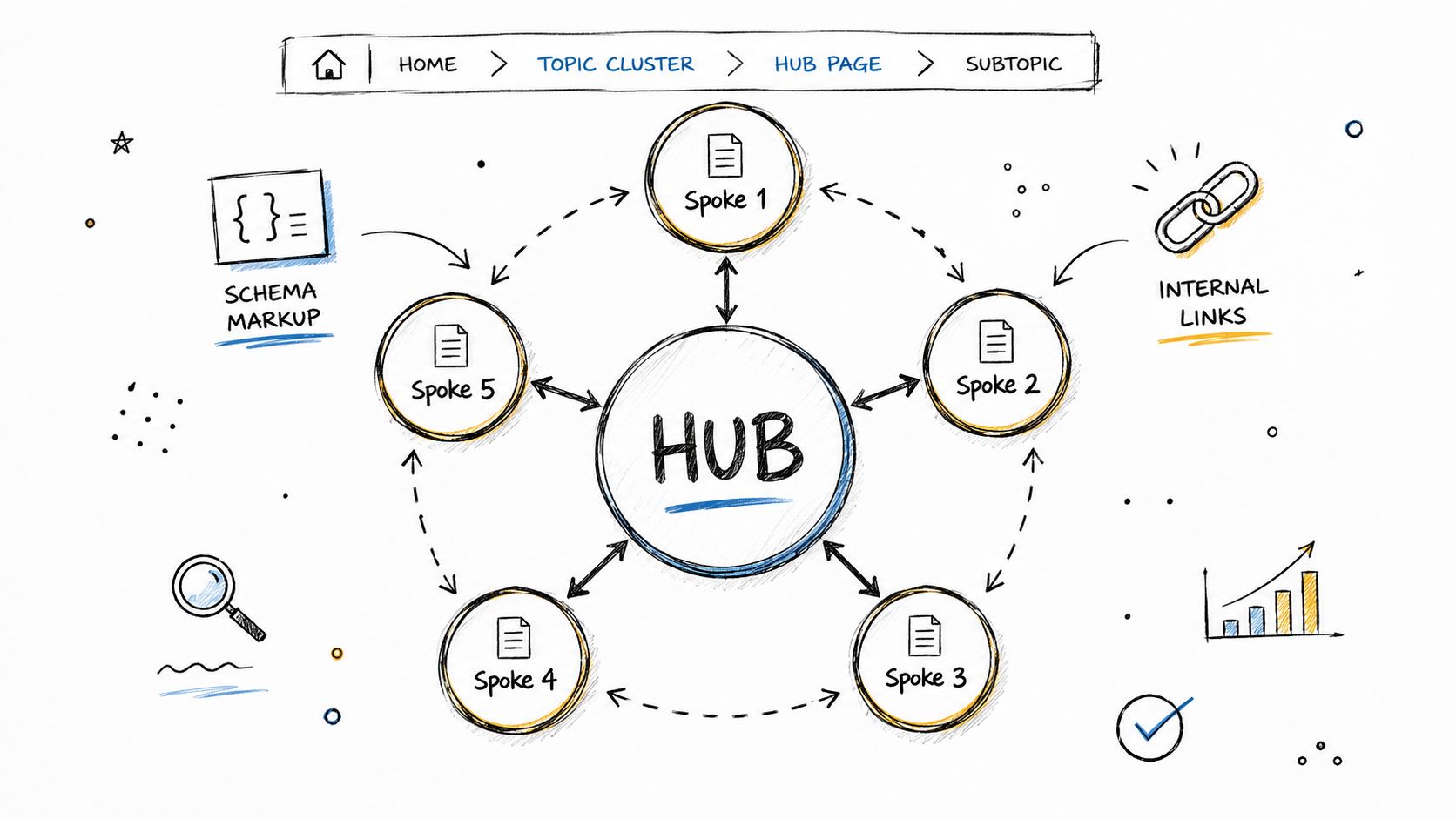
Build clusters from observed demand, not editorial preference
Start with a topic that already shows evidence of market fit. In GSC, export queries and landing pages, then group terms by shared entities, modifiers, and intent. If one page already captures broad informational demand while several related pages rank for narrower variants, that page is the likely hub. SiteWise maps then show whether the site structure supports that role or leaves related URLs disconnected.
Use Nuwtonic's internal linking audit guide to verify the cluster path. A hub should link down to spokes with descriptive anchors. Spokes should link back to the hub and laterally only where the user task overlaps. Pages with impressions but no meaningful internal references are often orphan candidates. Pages covering nearly identical subtopics are often consolidation candidates.
The result is a cleaner editorial model. It also gives teams a faster route from idea to publish-ready brief.
Turn a cluster into a production system
A useful post in this category should pair the topic idea with the assets needed to execute it inside Nuwtonic.
Keyword prompts: “[core topic] guide,” “[core topic] for [audience],” “[core topic] examples,” “[core topic] vs [alternative],” “[core topic] checklist,” “[core topic] mistakes”
Headline formula: “The [Core Topic] Hub: How to Choose, Compare, and Implement It for [Audience]”
AI content prompt: “Create a topic cluster for [core topic] using one hub and six spoke pages. Map primary and secondary keywords, search intent, internal link anchors, entity relationships, and consolidation risks.”
Execution workflow: Pull GSC page-query exports. Group terms into entity-led clusters. Review SiteWise maps for orphaned or weakly connected URLs. Assign one hub, supporting spokes, and pages to merge or prune. Generate briefs in Nuwtonic with target terms, internal links, schema suggestions, and section outlines. Draft with AI assistance, then route approved pages to the CMS.
That workflow is the differentiator. Readers do not just get a topic suggestion. They get a repeatable method that connects SEO diagnosis, editorial planning, AI drafting, and internal linking into one publishable system.
Show a concrete example
Consider a SaaS company writing about project operations. GSC shows impressions across queries such as “project management workflow,” “task prioritization framework,” “remote team collaboration process,” and “project tracking template.” SiteWise reveals those articles exist, but they sit in different folders, have inconsistent anchor text, and rarely reference one another.
A stronger cluster would make “project management workflow” the hub because it covers the broadest intent. Spokes would handle templates, prioritization methods, remote collaboration, and software comparisons. Nuwtonic can then generate the cluster brief, propose supporting headings for each spoke, draft internal link anchors, and flag pages that overlap enough to merge. That turns a loose archive into a clear topical system, which is more useful for readers and easier for search engines to interpret.
6. Identifying and Fixing Mobile Ranking and CTR Gaps Analyzing Desktop and Mobile Performance Deltas to Recover Mobile Visibility
A page can look healthy in aggregate and still underperform badly on mobile. That happens when teams only review blended search data. The page ranks well on desktop, converts acceptably on laptop screens, but loses visibility or clicks on phones because the snippet, load experience, or layout breaks intent.
That gap makes an excellent blog topic because it combines SEO analysis with UX fixes. It also tends to produce more actionable recommendations than broad “mobile SEO tips” articles.
Audit mobile intent separately
Start with device-segmented GSC exports and compare queries where mobile CTR or ranking visibly trails desktop. Then inspect the mobile SERP itself. On some results, competitors win with stronger image presence, more compact answers, or mobile-friendly page layouts that surface the right information immediately.
A local services firm can build a post around “near me” queries where location details and tap targets matter most. A B2B SaaS company can center the article on demo-request pages where desktop performs better because the mobile form asks for too much upfront. A retailer can focus on product pages where slow rendering or cluttered above-the-fold content suppresses clicks and engagement.
Execution ideas for mobile-first posts
Use a blog structure that compares diagnosis to remediation:
Keyword prompts: “mobile SEO audit,” “desktop vs mobile CTR gap,” “mobile search ranking fixes”
Headline formula: “Why Your Mobile Rankings Lag Behind Desktop and How to Fix It”
AI content prompt: “Draft a mobile SEO remediation guide using device-level performance data. Cover mobile CTR gaps, form friction, layout hierarchy, image handling, and page-speed checks.”
Workflow in Nuwtonic: Pull device-level deltas, sort by highest business-value pages, inspect mobile SERP features, audit page rendering, queue fixes for metadata, image handling, layout hierarchy, and mobile UX.
A useful supporting read for the concept of strong site-wide subject depth is Feather's explanation of topical authority. Pairing that perspective with mobile-specific diagnostics gives your article a sharper angle than a generic performance roundup.
Strong mobile performance often comes from subtraction. Fewer fields, fewer distractions, tighter copy, clearer hierarchy.
That framing resonates because it connects rankings to interface decisions, not just abstract SEO theory.
7. Scaling Content Production Using Entity-First Content Generation and Smart AI Edit From Outline to Published in Days Not Weeks
A content lead approves ten blog ideas on Monday. By Friday, the team has ten drafts, five conflicting keyword targets, three weak outlines, and no clear path to publish. The bottleneck is rarely draft volume. It is production design.
Entity-first content generation fixes that problem by structuring the brief before the model writes. The outline defines the primary topic, related entities, search intent, decision-stage questions, comparisons, objections, and required proof points up front. That reduces rework later, which is where many content teams lose time.
The shift matters because AI adoption has moved from experimentation to workflow use. Orbit Media reports that bloggers now use AI for tasks such as generating ideas, outlining, drafting, and editing, which changes the operational question from "should we use AI?" to "how do we use it without producing generic pages?" Their annual survey is useful here because it focuses on how bloggers work, not just broad interest in AI tools, as shown in Orbit Media's blogger survey.
Why entity-first production improves output quality
A standard AI prompt often produces readable copy with weak coverage. It misses adjacent terms, skips comparison angles, and underdevelops sections that matter for rankings and conversions. An entity-first outline gives the model a tighter map.
For a SaaS topic like "project management for remote teams," the outline should specify entities such as task dependencies, sprint planning, integrations, permissions, reporting, onboarding time, and pricing model. For a healthcare or legal topic, the entity set changes, but the logic stays the same. Define the concepts, terms, process steps, constraints, and audience-specific questions before drafting starts.
That approach also creates a cleaner review path inside Nuwtonic. Keyword Research identifies target terms. Clustering groups related demand. Entity-first Content Generation turns that demand into a structured outline. Smart AI Edit then refines clarity, consistency, and tone so editors spend less time rebuilding sections from scratch.
Execution ideas for high-output blog posts
This section works best as a post that teaches both strategy and operating procedure. Readers searching for ideas for blogging usually do not need another list of topics. They need a repeatable way to turn one topic into a publishable asset with search coverage, editorial logic, and metadata already in place.
Use a structure that pairs each blog idea with production inputs:
Keyword prompts: “[topic] for [audience],” “[topic] template,” “[topic] checklist,” “[topic] alternatives,” “[topic] mistakes”
Headline formula: “How to Achieve [Outcome] With [Topic] for [Audience]”
AI content prompt: “Create an entity-first outline for [topic] targeting [audience]. Include definitions, comparisons, objections, FAQs tied to search intent, examples, metadata suggestions, and sections needed for conversion-oriented readers.”
Execution workflow in Nuwtonic: pull keyword set, cluster by intent, generate entity map, build outline, draft with Smart AI Edit, run editorial review in Kanban, finalize metadata, send to publish queue through Content Autopilot
The non-obvious benefit is consistency across a content program. Once the workflow is standardized, a team can produce multiple posts from the same cluster without creating overlap, missing subtopics, or forcing editors to reframe every draft manually.
A strong article here should show one example end to end. Start with a blog topic. Attach the keyword prompts. Show the headline options. Add the AI prompt. Then walk through the Nuwtonic workflow that takes the piece from idea to CMS-ready draft in days instead of weeks.
8. Cross-cutting Implementation Workflow From Audit to Iteration
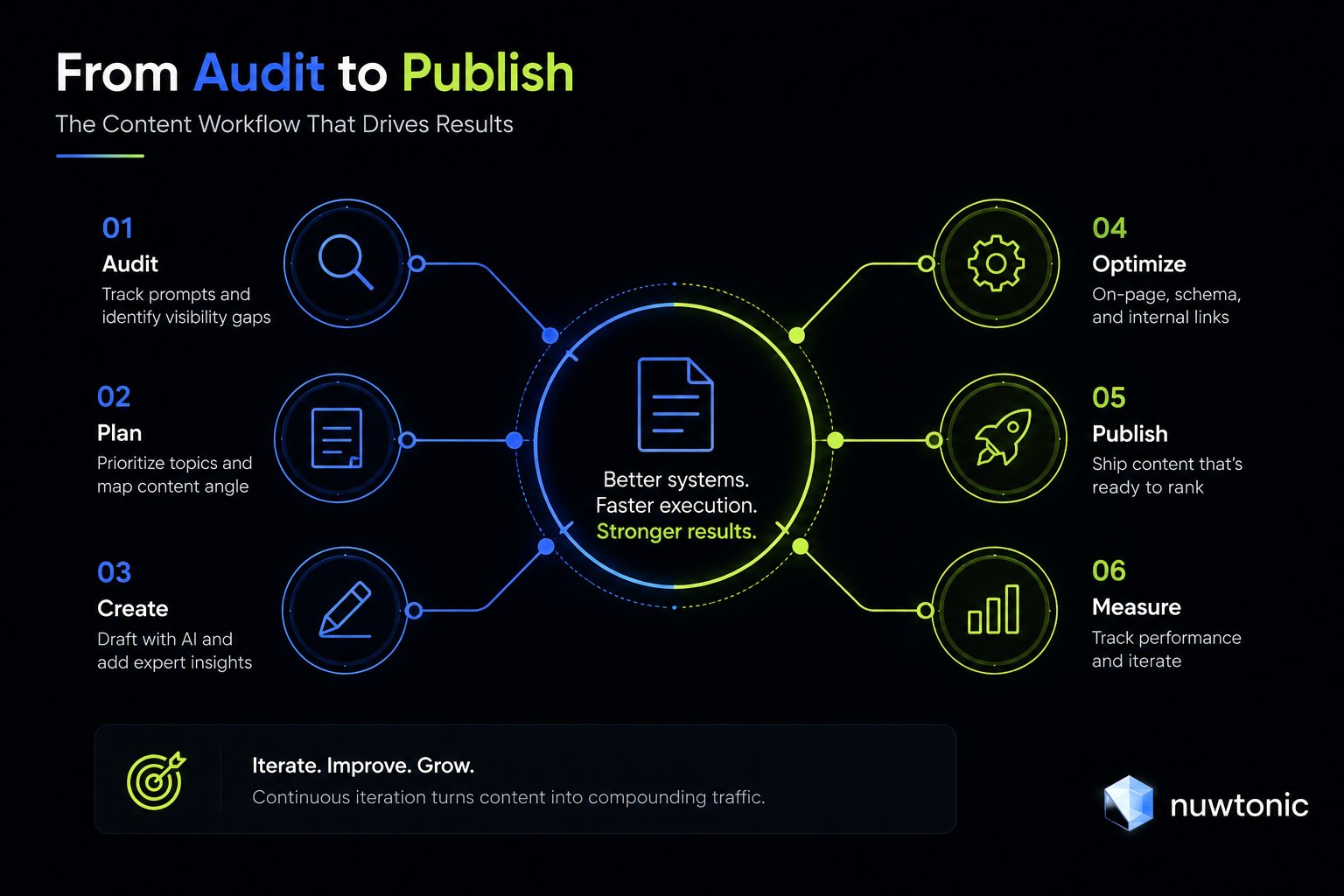
The most useful blog posts don't describe isolated tactics. They show how the tactics connect. A team auditing AI citations, fixing on-page gaps, cleaning cannibalization, and expanding topical clusters needs one operating sequence or work will pile up in disconnected spreadsheets.
That makes this a high-value “systems” post. It's especially useful for agencies, in-house SEO teams, and founders who need a workflow that keeps content production moving while still reacting to ranking changes and AI visibility shifts.
A practical weekly operating rhythm
A clean workflow starts with signal collection. Pull prompt-tracking data, GSC query trends, rank movements, and content conflicts into one queue. Then triage by impact. Pages losing visibility on buyer-intent queries go first. Pages already ranking but under-clicked often become the fastest wins. New cluster content comes after recovery work, not before it.
One reason this post has commercial value is that the market itself is large and still growing. The global blogging market is valued at $417.85 billion in 2025 and projected to reach $2 trillion by 2032 according to Twinstrata's market summary. In a market of that scale, workflow discipline matters because publishing more low-coordination content won't create durable share.
How to assign work across Nuwtonic modules
Use role-based ownership inside Nuwtonic:
Analyst: reviews GSC Performance Dashboard, SERP tracking, AI Search Agent findings
SEO lead: approves GEO, schema, metadata, and cannibalization actions
Writer or strategist: drafts patches, spoke pages, and new comparison or how-to posts
Editor: applies Smart AI Edit, voice review, and factual tightening
Ops or dev: approves deployable fixes and CMS pushes when needed
Build one queue, not five. Teams lose speed when audits, writing, and fixes live in separate systems with separate priorities.
For the blog itself, frame the article around a real sprint: Monday audit, Tuesday prioritization, Wednesday draft and fix queue, Thursday review, Friday publish and measure. That gives readers a model they can implement immediately.
9. Common Measurement Metrics for SEO and AI Visibility Work
On Friday, a team publishes three posts. By Monday, one page gained impressions but lost CTR, one started appearing in AI answers without sending visits, and one drove a small number of conversions from a narrow set of high-intent queries. If all three are judged on traffic alone, the team will misread what worked.
Measurement needs to match how discovery now happens across search results and AI assistants. For this topic, that means tracking two layers at once. First, standard SEO performance such as impressions, rankings, and clicks. Second, AI visibility signals such as prompt-level citation presence, answer inclusion, and paraphrased brand mentions across ChatGPT, Gemini, Perplexity, and Claude. Nuwtonic helps tie those layers together so teams can move from idea selection to publish-ready execution with a scorecard already defined.
Build a scorecard before the draft is written
A useful measurement model separates performance into three buckets:
Search visibility: rankings, impressions, query coverage, SERP feature presence, desktop versus mobile deltas
AI visibility: citation frequency by prompt set, competitor inclusion, answer positioning, mention accuracy
Business response: CTR, assisted conversions, lead quality signals, return visits, on-page engagement
That structure prevents a common error. Teams often treat AI citation as proof of success, even when the cited page attracts weak clicks or no commercial activity. The better reading is comparative. A page cited often but clicked rarely may need a sharper title, tighter metadata, or a clearer promise in the opening section. A page with modest visibility but strong conversion assists may deserve expansion, internal support, and faster refresh cycles.
Use different benchmarks for different post types
One scorecard across every format creates noise. A comparison post and a glossary page do different jobs in the funnel, so they need different review windows and success thresholds.
Use a simple format-by-metric model:
How-to posts: impressions, CTR, snippet capture, AI answer inclusion, scroll depth
Comparison posts: non-brand commercial query visibility, click share, assisted pipeline, prompt citation against named competitors
Cluster hub pages: ranking spread across the target topic, internal link clicks to spokes, indexed support pages, prompt coverage breadth
Recovery pages: regained queries, reduced cannibalization, restored CTR, prompt reappearance after updates
Nuwtonic's workflow matters operationally. The topic brief can define the target query set. The SEO module can attach metadata and schema tasks. AI Search tracking can monitor prompt inclusion after publish. Smart AI Edit can then tighten weak sections based on the first measurement cycle, rather than waiting for a full rewrite.
Review metrics on a fixed cadence
Daily checks create noise for most blog programs. Quarterly reviews are too slow for pages competing in active SERPs and AI answer sets. A tighter operating rhythm works better:
72 hours after publish: confirm indexing, metadata rendering, schema deployment, and prompt test inclusion
2 weeks: review impressions, CTR shape, early AI citation patterns, and title or intro mismatch
30 days: compare ranking spread, assisted conversions, query expansion, and competitor displacement
60 to 90 days: decide whether to refresh, consolidate, build supporting content, or hold steady
If you want an AI prompt for this section of the article, use: “Create a measurement framework for blog content that tracks SEO performance, AI answer visibility, engagement quality, and post-publication optimization triggers by content type. Include metrics, review cadence, and actions to take when a metric improves or declines.”
10. Quick-start Tips and Tactical Playbook
A content lead opens Monday's dashboard and sees the same pattern again. Dozens of blog ideas are sitting in a backlog, but none are tied to a target query set, a prompt test, or a publish workflow. The result is predictable. Teams ship posts, then spend weeks guessing why rankings stall, why AI answers skip the page, or why the draft never made it past review.
A useful tactical playbook fixes that operational gap. For this article, the standard is higher than “good topic ideas.” Each idea should move from topic selection to keyword prompts, headline formulas, AI drafting instructions, and a clear execution path through Nuwtonic's modules so the team can publish fast and measure what happened.
First actions to take this week
Start with one narrow batch, not a full editorial reset. Choose 10 to 15 pages, prompts, or query clusters that already matter to the business. Small samples make it easier to spot patterns in intent mismatch, weak metadata, thin entity coverage, or pages that rank in search but fail to appear in AI-generated answers.
That approach also reduces wasted production time. SmartPubTools' analysis of underserved topic validation and GEO visibility points to the same practical lesson: teams get better results when they validate topic demand and answer-format fit before scaling content production.
Use this sequence:
Pick one content set: comparison posts, how-to guides, product-led tutorials, or declining traffic pages
Assign a primary signal: ranking opportunity, CTR gap, prompt visibility gap, or conversion assist potential
Build the brief in Nuwtonic: define target keywords, related entities, search intent, and the prompt set to monitor
Draft with structure: use AI generation for the first outline, then refine with Smart AI Edit so the post answers the query directly and covers missing subtopics
Queue technical tasks: add metadata, schema, and publishing checks through the SEO module before the page goes live
Track post-publish performance: monitor search movement and AI inclusion so updates are based on observed gaps, not guesswork
Reusable headline formulas and AI prompts
Reusable templates improve output quality because they reduce blank-page decisions and keep the draft tied to an intent model.
Try headline formulas like these:
How to Fix [Problem] Using [Data Source, Workflow, or Signal]
A Practical Process for Improving [Outcome] Across [Channel, Page Type, or Use Case]
Why [Audience] Loses Visibility for [Topic] and How to Correct It
[Topic] Audit Template: What to Check, What to Change, What to Measure
Pair those with AI prompts that produce publishable raw material instead of generic copy:
AI content prompt: “Create a blog outline for [industry] targeting [keyword cluster]. Include search intent, audience pain points, entity coverage, section-level recommendations, schema opportunities, and likely AI-answer prompts.”
AI content prompt: “Turn these GSC queries and competitor gaps into one pillar post, two supporting articles, and one comparison article. For each piece, provide a headline, target keyword set, internal content dependencies, and post-publish metrics to monitor.”
AI content prompt: “Rewrite this draft to improve answer-first clarity, increase topical completeness, and align headings with prompt-style search behavior across ChatGPT, Gemini, Perplexity, and Claude.”
Tactical rules that keep execution tight
A playbook works when the team can apply it under deadline pressure.
Use fixed rules:
Update pages with existing impressions before creating net-new posts with no traction signal.
Group similar fixes into one sprint so editors and SEO reviewers are not switching contexts all day.
Record every merge, rewrite, redirect, and schema change in one shared log.
Review competitors for title shifts, format changes, and AI citation gains on a weekly schedule.
Treat every post as an asset with a workflow, not a one-time deliverable.
The practical advantage is speed with control. Nuwtonic's modules support that model directly. The topic brief defines what the article needs to rank for. The SEO workflow handles metadata and structured data tasks. AI Search tracking shows whether the page appears in prompt results after publishing. Smart AI Edit shortens the revision cycle when early performance exposes a weak section or missing answer block.
As noted earlier, blogs remain a strong channel for product education and demand capture. The posts that perform best usually do not start with broad inspiration. They start with a constrained topic, a measurable keyword and prompt target, a repeatable headline pattern, and an execution system the team can run this week.
10 Blogging Ideas: SEO & AI Strategy Comparison
| Item | Implementation complexity | Resource requirements | Expected outcomes | Ideal use cases | Key advantages |
|---|---|---|---|---|---|
| How to Audit and Fix AI Search Visibility Gaps Using Prompt Tracking Across ChatGPT, Gemini, Perplexity, and Claude | Medium–High: multi-model testing + schema/entity fixes | Prompt tracking tools or manual tests, SEO analyst, some dev/schema work, ongoing monitoring | Increased AI citation rate; measurable citation position improvements | Brands seeking visibility in LLM-generated answers and early GEO opportunities | Captures emerging channel, quantifies impact of structural fixes |
| Mapping Competitor Content Gaps and SERP Intent Shifts to Recover Share of Voice | Medium: SERP and intent analysis plus prioritization | Rank trackers, GSC, competitor intelligence tools, content ops | Prioritized content roadmap; recovered impressions/CTR and regained share-of-voice | Recovering category share where competitors gained intent-aligned features | Turns rank data into revenue-focused roadmap; detects click-decay |
| Running a Sitewide Cannibalization Audit and Implementing Conflict Resolution | Low–Medium: analysis-heavy; fixes are straightforward (merge/redirect) | GSC data, backlink audit, content editors, developer for redirects | Traffic consolidation and rank recovery for contested keywords | Sites with many overlapping pages (e-commerce, publishing) | High ROI; relatively quick implementation and measurable consolidation |
| Turning GSC Query Data Into Prioritized On-Page Fixes | Low–Medium: mapping queries → metadata/schema fixes at scale | GSC access, CMS automation or dev support, SEO/content editors | Faster CTR improvements and incremental click gains; short-term ROI | Improve CTR of already-ranked pages (ranks 4–10) for quick wins | Data-driven, repeatable fixes; bulk deployment via CMS |
| Building Topical Authority and Avoiding Orphaned Content | High: content restructuring, hub/spoke strategy, entity mapping | Significant content production, editorial planning, internal-linking work | Long-term cluster-wide rank gains and stronger entity signals | Sites aiming for sustained authority across complex topics | Improves topic-wide rankings and reduces orphaned pages |
| Identifying and Fixing Mobile Ranking and CTR Gaps | Medium–High: UX + engineering + CWV optimization | Dev/UX resources, RUM/CWV tools, GSC device segmentation | Mobile rank and CTR recovery; improved Core Web Vitals | Sites with mobile vs. desktop performance deltas or mobile-first needs | Addresses mobile-first indexing; often high-impact recovery opportunities |
| Scaling Content Production Using Entity-First Content Generation and Smart AI Edit | Medium: workflow and guardrail setup for AI-assisted production | AI/content tooling, editors, style guides, review process | 3–5x faster content output with maintained brand voice and entity depth | Organizations needing to scale content without sacrificing consistency | Entity-first depth, brand-voice controls, automated edits for speed |
| Cross-cutting Implementation Workflow: From Audit to Iteration | Medium: coordination across audits and teams | Cross-functional team, centralized tracking, monitoring tools | Cohesive, repeatable improvement cycle and faster iteration | Organizations running multiple SEO/AI initiatives concurrently | Standardizes process and prioritization across efforts |
| Common Measurement Metrics for SEO & AI Visibility Work | Low (conceptual); medium to implement dashboards | Analytics/GSC access, dashboarding tools, attribution setup | Unified KPIs to evaluate impact and prioritize work | Teams needing consistent measurement across SEO and AI projects | Provides consistent, comparable success metrics across initiatives |
| Quick-start Tips and Tactical Playbook | Low: tactical checklists and prioritization | Minimal tooling; small test teams, GSC access | Fast, actionable wins and baseline for scaling | Small teams or teams initiating SEO/AI programs | Practical, prioritized actions that deliver early results |
Time to Turn Ideas Into Posts
A content lead pulls last quarter's report and sees the familiar pattern. Dozens of published posts, uneven rankings, weak pickup in AI-generated answers, and a backlog of drafts that never made it through review. The problem usually is not a lack of ideas. It is a lack of operational design.
The 10 ideas above work because each one starts with a measurable visibility problem and ends with a repeatable production path. Instead of stopping at topic selection, they connect a blog concept to SEO keyword prompts, headline formulas, AI drafting instructions, review criteria, and execution steps your team can run inside Nuwtonic. That approach closes the gap between ideation and publication, which is where many editorial plans lose momentum.
Publishing software is widely available, as noted earlier. The harder advantage now is choosing topics with recoverable business value, then shipping them with enough structure to perform in search results and AI answer engines. A strong blog idea is less like a creative prompt and more like a work order. It should specify the target query pattern, the audience problem, the evidence needed, the page structure, and the post-publish checks.
Format choices affect outcomes too. Readers process visual explanations faster than dense text, especially in posts about audits, workflows, and technical remediation. For this set of ideas, that means using screenshots from GSC, prompt comparison tables across ChatGPT and Perplexity, before-and-after title tag examples, schema snippets, internal linking maps, and short process visuals. Those assets improve readability and make the post more useful for both human readers and systems evaluating page structure.
AI speeds production only when the workflow is controlled. Teams get the best results when AI handles pattern-based work such as outlining, first-pass section drafting, entity expansion, and metadata options, while editors review for factual accuracy, business context, brand voice, and missing nuance. That division of labor fits the way Nuwtonic is positioned across these ideas: prompt tracking for AI visibility analysis, GSC-led prioritization for fix selection, entity-first drafting for speed, and review-before-deploy controls to keep output usable.
The practical test is simple. If a topic cannot be translated into a keyword set, a search intent model, an outline, an AI prompt, an editing checklist, and a publish workflow, it is still too vague to schedule.
Start with the idea closest to current performance pressure. A team losing rankings may begin with competitor gap mapping or cannibalization cleanup. A team with scattered coverage may get more value from a topical authority and internal linking piece. A team struggling with slow output may prioritize the entity-first production post, then use that same workflow internally to reduce cycle time on the next batch of articles.
Then build the draft like an analyst. Define the primary query and adjacent entities. Pull the SERP pattern. Write a headline that reflects intent rather than internal jargon. Generate an outline that answers the query in the order users expect. Add metadata, schema, visuals, and examples. Run an editorial review that checks accuracy, differentiation, and internal consistency. Publish, measure, and revise based on real impressions, clicks, and AI citation patterns.
If you want a useful companion for planning structure before drafting, Whisper AI's blog post outline guide is a good reference point for turning rough ideas into a clean editorial skeleton.
Nuwtonic helps SEO and content teams turn these ideas into publish-ready work without juggling separate tools for audits, AI search visibility, on-page fixes, content generation, clustering, and deployment. If you want one workspace for prompt tracking, GSC-led prioritization, entity-first drafting, competitor gap mapping, and review-before-deploy execution, explore Nuwtonic.